Beyond brinksmanship: The Orientalism in Trump's Iran war cry
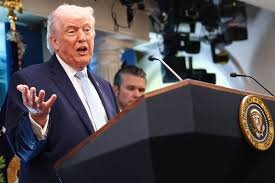
NEW DELHI - In a striking display of aggressive posturing amid the war on Iran, United States President Donald Trump’s apocalyptic warning of total annihilation in a prime-time television address from the White House has since been reverberating around the world. Demonstrating how his “madman attitude” has made the world more uncertain, he declared that the U.S. army would be hitting Iran “extremely hard,” if his demand of lifting the siege on the Strait of Hormuz would not be heeded by the Islamic Republic Guards Corps (IRGC).
Invoking archaic phraseology, he prepared to bomb Iran and “bring it back to the Stone Ages, where they belong,” while delivering a self-congratulatory address over a supposed “victory” against Iran. This salvo was followed by his hawkish secretary of war, Pete Hegseth, repeating the words on his X social media handle.
In quick succession, Trump threatened that Iran’s “whole civilization will die tonight.” These remarks, delivered as part of a broader justification for ongoing U.S.-Israeli aggression against Iran, have been widely interpreted not merely as a threat of military escalation but as a revealing moment in the cultural logic underpinning American coercive foreign policy discourse.
The jarring statements come from the leader of a “free” and “liberal democratic” country, threatening to erase a people whose intellectual and cultural legacy has enriched humanity for millennia. A nation that came into being a mere 250 years ago and has acted as a global policeman since the beginning of the Cold War is now threatening a country that possesses a sophisticated and glorious 6,000-year-old civilizational history, with widespread casualties and the destruction of civilian infrastructure. The targeting of civilian lives and infrastructure is not only a brazen violation of international law, but also a brutal affront to the human sensibilities of a civilized society. This also raises deeply unsettling questions about the international order triggered by such audacious genocidal threats.
Nonetheless, the Iranian people’s resilience and defiance in the face of aggression reveal something profound. They are not simply citizens of a modern nation-state, but heirs to an ancient Persian civilization later shaped by Islamic values. Iran, historically rooted in Persian civilization and shaped by modern Islamic ideals and Shia revolutionary fervor, reflects a continuity that transcends the present conflict. From the very beginning of the war, Iranians have crafted a powerful counter-narrative and wielded potent symbolism. This is truly remarkable and deserves recognition. The country has long been associated with a rich intellectual and cultural legacy, marked by significant contributions to science, mathematics, medicine, architecture, literature and poetry, and philosophy that continue to influence the world even today.
Trump’s “Stone Age” brinkmanship is not merely a hyperbolic expression, and it cannot be ignored. The imagery he employs is not only profoundly dehumanizing and laden with profanity, but also reflects a colonial mindset rooted in Western arrogance toward countries of the Global South. Departing from the relative restraint of his predecessors, Trump goes even further by hurling expletives at Iranians. However, in tone, structure, and underlying intent, his statement is not new; rather, it is the latest manifestation of what the late literary theorist Edward Said identified as “Orientalism.” He expounded this groundbreaking concept in 1978 that revolutionized the study of the East by deconstructing the Western discourse that shaped it.
Critics argue that Western propaganda’s habit of demeaning and stereotyping non-Western societies is not unintentional, but a deliberate strategy. The psychology behind these narrative constructions is to demoralize the “ruled” and reinforce the Orientalist framework that Edward Said described as a “corporate institution” in dealing with the non-Western states. This phenomenon is also associated with the “Oriental gaze,” and defined as a deep-seated bias that perceives non-Western, and particularly Muslim societies, not as equal, but as primitive, static, and inferior to justify Western hegemony.
Said’s idea of Orientalism explains how the region has historically been depicted as irrational, unstable, and fundamentally different from a supposedly logical and orderly West. This perspective continues to shape modern discourse, as conflicts involving West Asia are frequently analyzed through lenses that prioritize Western notions of global order and rational behavior. In the rhetoric against Iran, this tendency has resurfaced more intensely than ever.
It has rekindled debates over American hegemony and its willful failure to engage with Oriental discourses. The phrase carries significance that extends beyond its shock-and-awe strategy. The United States has a history of invoking “Stone Age” rhetoric, often implying large-scale death and destruction in the course of its military interventions in Japan, Vietnam, Afghanistan, and Iraq. In the 1960s, similar rhetoric was invoked by U.S. Air Force Commander Curtis LeMay during the Vietnam War. Later, President George W. Bush used similarly polarizing language during the war on terror that followed the Iraq War in 2003, frequently speaking of defending “civilized” values against “evil-doers,” reinforcing the idea of a civilizational struggle between the West and the Muslim world. That rhetoric triggered an unprecedented rise in Islamophobia worldwide. Like many of his predecessors, Trump also lacks knowledge and respect for history. By consistently failing to engage with Iran’s historical depth and civilizational pride, successive U.S. administrations have not only pursued a series of reckless policies but also missed opportunities for meaningful diplomacy with the Islamic Republic.
In this framing, Iran is not a nation with a rich, continuous civilization, but an entity of irrationality, backwardness, and religious fanaticism being governed by regressive clergy. The problem of a modern nation-state like the U.S. in its engagement with different cultures and traditions is characterized by a lack of nuanced and contextual understanding of history and the different shades of cultures and sub-cultures within a society. When it comes to the intersectionality between the “modern” and “traditional” societies, the West often perpetuates a discourse that tries to construct the Global South, or indeed the East, as an inferior, irrational, and backward 'other' to justify its geopolitical hegemony.
If Iran were to compare its civilizational and cultural achievements, from the 6th century BC Cyrus the Great’s clay cylinder, widely considered the world’s first charter of human rights, to the modern inheritors of its poetic and scientific tradition, the West, including the U.S., would no longer appear as a forerunner of civilized society. At that time, much of the West was still in prehistory, while the Achaemenids, Sasanians, and later the Safavids were thriving in Persia. It endured the storms of Alexander and the Mongols and has continued to thrive across millennia. Its culture has flourished and left its imprint on both East and West alike. The Iranian people cannot be easily intimidated as such attempts only serve to galvanize their collective resolve to confront the foreign intervention.
Trump’s “Stone Age” rhetoric reflects more than mere provocation; it also manifests Orientalism to maintain geopolitical hegemony. It exposes a deeper failure to understand Iran’s deep-rooted intellectual and cultural foundations. By reducing Iran to a disparaging and dehumanized image, such discourse rules out the possibility of meaningful engagement and diplomacy. Yet such discourses ultimately fail. Iranian resilience, rooted in history, memory, and language, cannot be subdued through coercion or intimidation. Iran’s defiance reminds us that true power lies not merely in bombs and missiles, but in people’s resilience. Such aggressive language perpetuates instability and cycles of violence. The present international scenario demands a paradigm shift beyond Orientalist assumptions toward greater mutual respect and deeper historical and cultural understanding. Without such a shift, strategic miscalculations will continue to repeat, intensifying conflicts whose repercussions will extend far beyond the region and ultimately leading to the fall of the American empire.
Dr. Yasir Ali Mirza is a Visiting Research Fellow at IPSA, New Delhi
Leave a Comment